Urban Drone Warfare and the Crisis in Haiti
September 23, 2026
10:00am
Webinar
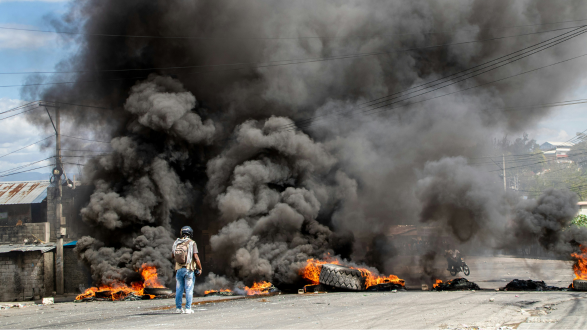
NEW DATE & TIME: On Wednesday, September 23, at 10 am PT, the Pacific Council will host a webinar examining the rapid proliferation of armed drone technology in urban conflict environments, with a focus on the ongoing security crisis in Haiti. As explosive quadcopter drones become a fixture of 21st-century urban warfare, Port-au-Prince has emerged as an unlikely laboratory for some of the most consequential questions in international security today: How should states balance tactical effectiveness against civilian protection? What regulatory frameworks, if any, govern the deployment of lethal autonomous and semi-autonomous systems in densely populated neighborhoods? And what role do private military contractors play when operating at the edges of international law?
Since March 2025, Haitian security forces and private contractors have conducted over 140 drone operations targeting gang-controlled neighborhoods across Port-au-Prince. Operating under a government task force with support from U.S.-licensed private military firm Vectus Global, these strikes have produced significant casualties while raising profound questions about accountability, transparency, and the future of security assistance in fragile states.
Why it's important:
- Human Rights Watch documented at least 1,243 people killed and 738 injured across 141 drone strike operations between March 2025 and January 2026, including at least 17 children and 43 adults with no apparent ties to criminal groups. The UN Integrated Office in Haiti has attributed the campaign to a specialized government task force operated with support from Vectus Global, a private military company whose export of defense services to Haiti was licensed by the U.S. State Department.
- Amnesty International has warned that the use of armed drones in densely populated urban areas sets an alarming precedent, placing civilian populations at direct risk and raising the specter of probable extrajudicial executions.
- The tactical advantages of drone strikes, including reduced risk to state personnel and enhanced surveillance capacity, may come at the cost of long-term strategic stability, particularly given the risk that drone technology could diffuse to nonstate actors such as the very gangs being targeted. Haiti's security crisis offers a cautionary case study in how technological asymmetry in gray-zone conflicts may be difficult to sustain.
Speakers include:
- Diego Da Rin, Haiti Analyst, International Crisis Group
- Sophie Rutenbar, Nonresident Fellow, Strobe Talbott Center for Security, Strategy, and Technology, Foreign Policy Program, Brookings & Visiting Scholar, Prevention and Peacebuilding Program, Center for International Cooperation, New York University (NYU)
- Henry Ziemer, Fellow, Americas Program at the Center for Strategic and International Studies (CSIS)
To register for this webinar, visit the Zoom Registration Page.
Guest Speaker
Diego Da Rin is the Haiti expert at the International Crisis Group. He holds a law and philosophy degree from the University Paris 1 Panthéon-Sorbonne and a master's degree in international and European studies from the Institute of Latin American Studies of the Sorbonne Nouvelle University. For over four years, his research at Crisis Group has been dedicated to analyzing Haiti's intersecting crises, with the objective of formulating recommendations for key stakeholders to restore security and foster political stability in the country.

Guest Speaker
Sophie Rutenbar is a nonresident fellow in the Strobe Talbott Center for Security, Strategy, and Technology in the Foreign Policy program at Brookings. She also currently works as a visiting scholar with the Prevention and Peacebuilding Program of the New York University Center for International Cooperation.

Rutenbar was previously the mission planning officer for the United Nations Integrated Office in Haiti. Based in Port-au-Prince, Haiti, she worked in the front office of the Special Representative of the Secretary-General, conducting strategic planning for the United Nations in Haiti. Before that, she served as political affairs officer with the policy planning team of the United Nations Department of Peace Operations. In that role, she worked extensively on U.N. peacekeeping and peace and security reform processes, including supporting the Action for Peacekeeping Initiative (2018-present), the secretary-general’s Peace and Security Restructuring (2017-18) and the High-Level Independent Panel on Peace Operations (2015). Rutenbar also helped lead efforts to enhance U.N. peace operations’ capacity to respond to the evolving technology landscape and strengthen U.N. efforts to engage with non-state armed groups.
Her other experience at the U.N. has included working with the United Nations Department of Field Support, United Nations Mission in South Sudan, and the U.N. Secretary-General’s high-level panel on the global response to future health crises. She joined the United Nations in 2013 as the first U.S.-sponsored associate expert/junior professional officer in the U.N. Secretariat, working with the policy planning team for the Departments of Peacekeeping Operations and Field Support.
Before joining the U.N., Rutenbar worked for organizations in Sudan and South Sudan, including observing the 2011 referendum process on independence for southern Sudan with the Carter Center and working for USAID’s Sudan and South Sudan Transition and Conflict Mitigation Program. She also has experience in the Democratic Republic of the Congo, Zambia, and Thailand.
She was a 2005 Truman Scholar and previously served as co-president of the board of the Truman Scholars Association. She is also a security fellow with the Truman National Security Project. Rutenbar graduated magna cum laude from the University of Texas at Dallas, where she studied global politics as a Eugene McDermott Scholar. Through the Marshall Scholarship, she received master’s degrees in conflict, security, and development from the War Studies Department at King’s College London and in human rights from the London School of Economics and Political Science.
Moderator
Henry Ziemer is a fellow with the Americas Program at the Center for Strategic and International Studies (CSIS) in Washington, D.C. His research focuses on geopolitical competition, organized crime, and emerging technologies in the Americas. He has led investigations into China’s use of ports as levers of geopolitical influence, the use of drones by organized crime, and U.S. defense priorities in the Western Hemisphere. He has testified before the U.S.-China Economic Security and Review Commission, and his writing and analysis have been featured in Foreign Affairs, Foreign Policy, the Financial Times, and War on the Rocks. Before joining CSIS, he worked as a United States researcher at the Armed Conflict Location and Event Data Project (ACLED). Mr. Ziemer holds a BA in global affairs and history from Yale University.

To register for this webinar, visit the Zoom Registration Page.