Q&A with Jonathan Abbott
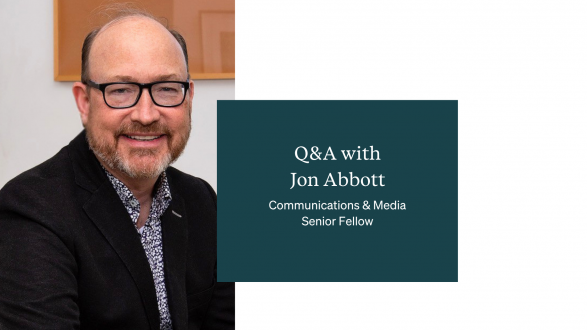
Jon Abbott is a nationally recognized media executive whose career reflects an enduring commitment to public interest journalism and the innovative delivery of educational content. As President & CEO of GBH for fifteen years, he helped reshape how public media reaches audiences and championed the digital transformation of public broadcasting at a national scale. Now bringing that wealth of experience to his role as Pacific Council Communications & Media Senior Fellow, Jonathan shares his perspective on the pressures facing global journalism and how storytelling can serve as a bridge between complex global events and the everyday lives of Americans.
What is a story in communications and media that you think is not being told but should be?
I’m concerned about the future of coverage (and audiences for) international stories and journalism. The significant shake-up in media (both making and consuming) is amplified with respect to global stories. Fracturing audiences, reducing investments in coverage and beats, and the shift to consumption on algorithm-driven social platforms place a premium on adaptation. We need innovations to focus reporting, enhance contextual storytelling, and develop new methods to reach citizens with global coverage.
Where is the current media landscape getting it right? Where do you feel it is most broken?
The pressures on media today make the “horse race”, tracking daily developments and “breaking” news of immediate interest, the principal focus. And where those stories impact everyday Americans and their household budgets, there’s more likely to be deeper coverage. The reporting on the tariffs Trump has implemented, and their implications, has been substantive, especially when those stories are framed in terms that audiences understand.
Unfortunately, what suffers are context and background stories that help audiences see current events in a historical frame or examine possible ramifications. The complexity and interdependence of our global relationships are under-examined.
What is a policy conversation you are watching closely right now, and what is your take on it?
I’m fascinated by the heterogeneity of interests across the Gulf states and how they are wrestling with the Iran war and their future posture toward the West. The landscape has shifted remarkably, diplomatically and economically, in the Gulf over the last thirty years (where Americans draw comparisons to earlier conflicts). Leaders recognize the practical imperative of accessing trade and managing opportunities with the U.S., China, and Europe.
What would you like to see your work as a Senior Fellow address or change in the communications and media landscape, or how people think about communications and media?
I think the Pacific Council can play an impactful role in supporting the reporting and discussion of global issues in a way that brings issues “home” to people in a timely, compelling way. Americans often dismiss international stories as disconnected or far afield from their daily lives. With thoughtful storytelling, I think we can help newsrooms and reporters make “global” issues “local”. As I mentioned, newsrooms face tremendous pressures and constraints. The Pacific Council can be an invaluable, trusted resource, and the Fellows can help!
Learn more about the Pacific Council Senior Fellow Program.