When the Ground Shifts: Venezuela's Earthquake, Institutional Failure, and a Con
July 29, 2026
9:00am
Webinar
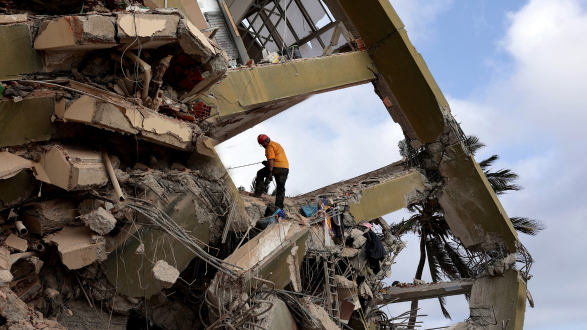
On June 24, 2026, twin earthquakes measuring 7.2 and 7.5 magnitude struck Venezuela's Yaracuy state in the most violent seismic event the country has experienced since 1900. The death toll has surpassed 3,800, with more than 16,700 injured and roughly 80 percent of buildings in La Guaira collapsed. In partnership with Espacio Crítico, the Pacific Council is hosting a webinar on Wednesday, July 29, at 9 am PT to examine Venezuela's post-natural-disaster institutional collapse, public health crisis, and political trajectory.
A preliminary UN Office for Disaster Risk Reduction assessment puts direct physical damage at $37 billion, nearly double Venezuela's entire 2026 budget, against the backdrop of $240 billion in liabilities and an economy reduced to roughly a third of its 2012 size. The earthquake intensified an already volatile political situation, with interim authorities failing to respond comprehensively: rescue units operated without equipment or fuel, hospitals ran out of medicine and water, and civil society organizations and foreign rescue teams found their access blocked. Into that void stepped neighborhood associations, NGOs, diaspora networks, and the political opposition, with Transparencia Venezuela's platform, RutaDeAyuda.org, tracking $694 million in aid from 37 countries and 68 organizations, including the United States, which pledged more than $386 million and deployed approximately 2,000 troops.
Why it's important
- With physical damage nearly double Venezuela's 2026 budget and no functioning insurance market, CSIS analysts warn that the reconstruction challenge is compounded by the contested legitimacy of the government nominally responsible for leading it, forcing international donors to choose between routing aid through state structures that failed the initial response and bypassing them at the risk of reinforcing state irrelevance.
- PAHO reports that facilities across La Guaira, Caracas, and Miranda are overwhelmed and urgently need outside assistance, with one hospital cramming 96 patients into an eight-bed ward, ventilators offline, and morgues beyond capacity. All this in a health system that already faced shortages of up to 37 percent of essential medicines before the disaster, with PAHO having launched a $23.9 million six-month appeal to sustain the most basic life-saving interventions.
The Washington Post reports that Rodríguez's 180-day mandate expired with no resolution from the National Assembly, leaving Venezuela in constitutional limbo at the precise moment that large-scale reconstruction decisions must be made.
To register for this webinar, visit the Zoom Registration Page.
Speakers include:
- Dr. Julio Castro, Physician & Public Health Researcher
- Mercedes De Freitas, Executive Director, Transparencia Venezuela
- Oswaldo Ramírez, Director, ORC Consultores
- Moderator: Miguel Pizarro, Director, Espacio Crítico
Guest Speaker
Dr. Julio Simón Castro is a Venezuelan physician and public health researcher specializing in infectious diseases. He completed his medical training at the Universidad Central de Venezuela and Hospital Vargas de Caracas, followed by a clinical and research fellowship at Harvard Medical School's Deaconess Beth Israel Medical Center and training in statistical analysis and epidemiology at the Harvard School of Public Health. He has served as a Full Professor at the Tropical Medicine Institute at UCV, Health Director of Sucre County in Miranda State, and is the current president of the Venezuelan Chapter of ISPOR, the International Society of Pharmacoeconomics and Outcomes Research. His research spans HIV/AIDS, nosocomial infections, Chagas disease, dengue, and antimicrobial resistance, with peer-reviewed publications in journals including the Journal of Infectious Diseases, Clinical Infectious Diseases, and Antimicrobial Agents and Chemotherapy. He has contributed to Pan American Health Organization guidelines on antibiotic use and hospital infection costs across Latin America, and serves as an editorial consultant on medical affairs for the Venezuelan literary publication Prodavinci.

Guest Speaker
Mercedes De Freitas studied History at the Universidad Central de Venezuela and completed specialized programs in Management and Organizational Development at the Instituto de Estudios Superiores de Administración (IESA), and in Effective Management of Non-Governmental Organizations at Queensland University, Brisbane, Australia.

Founder and Executive Director of Transparencia Venezuela, and a member of the Board of Directors of Transparency International from 2014 to 2017. She has directed Cívitas Venezuela since 2005. In 2016, she founded and directed Vendata. In 2006 she co-founded Crea Resultados. In 2017 she launched and led CampusTransparencia.com, an online training platform on transparency, justice, integrity, and anti-corruption; and in 2019, Espaja.com, a news and discourse verification platform, and the national Anti-Corruption Coalition movement. She co-founded and directed Becrack in 2020. She is a member of the coordinating team of Quiero Elegir.
Since 2020, she has served on the board of the Venezuela Corruption Taskforce. Since 2023, she has been a member of the Board of Directors of the Latin American and Caribbean Network for Democracy (REDLAD). She was invited as a civil-society speaker to the United Nations Security Council in special sessions on Venezuela in September 2018 and January 2026.
Since 2000, she has been a Fellow of Ashoka, the global network of social entrepreneurs, and in 2006 she won Ashoka's Champion ChangeMakers award. In 2019 she received the Anti-Corruption Leader Annual Award from the Americas Society/Council of the Americas. She was a member of ChangeMakers United in 2021. In 2024, she received Transparency International's Amalia Award for Individual Professional Excellence.
She has led more than 70 investigations into corruption networks, money laundering, and organized crime in Venezuela; has designed and directed dozens of events; and has been invited as a speaker and panelist at dozens of international events across dozens of countries.
Guest Speaker
Oswaldo E. Ramírez is the founder and Director of ORC Consultores, who established the firm with a focus on strategy, political risk, and political intelligence, maintaining a presence in both Venezuela and the United States. He also founded and owns the polling firm Frequency58 and serves as a senior associate consultant at De Vengoechea & Partners. He holds a degree in political science from the Central University of Venezuela (UCV), with specializations in public finance (UCAB) and public management (UNIMET). Is a member of the International Association of Political Consultants (IAPC), the Venezuelan Association of Political Consultants (AVENCOPOL), and the Latin American Association of Political Consultants (ALACOP). Over the past 20 years, he has served major multinational companies and corporations with interests in Venezuela and has advised presidential campaigns in the region.

Moderator
Miguel Pizarro is a Venezuelan activist with extensive experience in human rights, international advocacy, and strengthening civil society in contexts of democratic backsliding. Throughout his career, he has worked closely with civil society organizations, multilateral bodies, governments, cooperation agencies, and international organizations to raise awareness of the Venezuelan crisis, promote the protection of fundamental rights, and seek solutions to the humanitarian emergency.

He was elected deputy to the National Assembly of Venezuela in 2010, at the age of 21, and was re-elected in 2015, representing one of the largest popular neighborhoods (barrios) in Latin America. Since 2019, he has held various positions as a representative to the United Nations (UN) and in the area of foreign relations.
His experience in international coordination has been key to promoting measures against those responsible for human rights violations, channeling humanitarian aid, and advancing accountability mechanisms in forums such as the UN, the Organization of American States, and the International Criminal Court. He has actively participated in the drafting and follow-up of resolutions on Venezuela at the UN Human Rights Council, as well as in monitoring initiatives linked to the humanitarian emergency and the progressive shrinking of civic space in the country.
His experience in advocacy, political strategy, and international cooperation has made him a central figure in the fight against authoritarianism and in the search for solutions in crisis contexts.
To register for this webinar, visit the Zoom Registration Page